



Central Banks Face Difficult Decisions
The sharp rise in energy prices caused by the war in the Persian Gulf is making it difficult for economists to provide a clear assessment of the inflation outlook. The key question is how much higher energy prices will affect consumer spending, inflation, and the economy—and, above all, whether they will trigger second-round effects on wages and services.
Expectations are clear for the European Central Bank’s (ECB) September meeting, which this time will be held in Berlin rather than Frankfurt as part of its annual “off-site” meeting. Anything other than a 25-basis-point rate hike, bringing the rate to 2.5%, would be a surprise.
At the June meeting, when the ECB also raised rates by 25 basis points, ECB President Christine Lagarde (pictured below) outlined a list of criteria that would be taken into account when making interest-rate decisions.
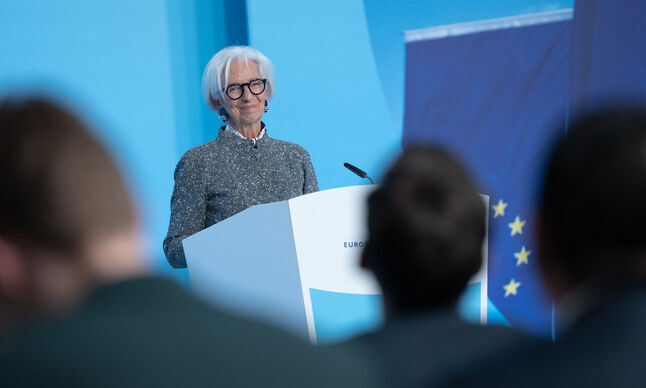
(Image: EZB)
«Some members of the Governing Council have asked whether we should consider a rate hike,» Lagarde said in June. «We were appropriately positioned to wait and closely monitor developments and the data we would receive over the coming weeks.» Observers interpreted this as a signal that the ECB was preparing for a September hike.
Rate Hike More of a Safeguard Than a Necessity
Based purely on the latest economic data, several economists say a rate hike is not necessarily warranted. «Both the price components of the purchasing managers’ indexes (PMIs), as well as negotiated wage growth and survey-based inflation expectations, point to easing underlying price pressures,» writes Laura Cooper of U.S. asset manager Nuveen, for example. She therefore sees the expected move more as a precautionary measure in case second-round effects do emerge.
U.S.: Majority Does Not Expect Rate Move Before Midterms
Unlike in the eurozone, most experts do not expect the Federal Reserve’s Open Market Committee (FOMC) to change interest rates at its meeting next week. The target range would therefore remain at 3.50% to 3.75%.
In the United States, too, high oil prices are weighing on the economy and pushing up inflation. Federal Reserve Chair Kevin Warsh recently expressed concern about persistent inflation while describing the labor market as «fairly stable.» Both headline and core inflation in the U.S. continued to decline in July, to 3.4% and 2.5%, respectively. Earlier this week, unexpectedly strong nonfarm payroll figures had increased expectations for a rate move.
Breaking with the consensus, analysts at Bank of America see the Fed continuing to raise rates. They expect a cumulative 75-basis-point increase by year-end. Robust economic growth and persistent inflation argue in favor of further hikes. «Growth is solid, the labor market is broadly in balance, inflation remains too high to declare victory, and monetary policy has become too loose,» the bank said in its latest analysis.
A rate hike ahead of the midterm elections scheduled for November would also bolster the central bank’s credibility and could be viewed as evidence of its independence from political influence.
Swiss National Bank in a Comfortable Position
The latest economic data from Switzerland, showing GDP growth of 1.5% in the second quarter, exceeded economists’ expectations. According to analysts at Swiss Life, growth is above potential.
«If domestic demand were to continue growing at this pace, it would result in signs of overheating,» they said. In that case, inflation risks would have to be considered. So far, however, there are still no signs of such risks.
Second-round effects in response to higher energy prices have so far failed to materialize, either at the producer or consumer level. Annual inflation stood at 0.8% in August.
Weaker Franc Helps Exporters
For the Swiss National Bank, this means its zero-interest-rate policy can remain in place for the time being. «Inflationary pressure is currently still too low, and the franc is also too stable to warrant any adjustment to interest rates,» Caroline Hilb of Raiffeisen recently said in an interview with Swiss public broadcaster SRF.
The fact that the euro has recovered noticeably against the franc in recent weeks is a small relief for Switzerland’s export industry. The impact of imported inflation, meanwhile, is relatively negligible.


